
Hand signals
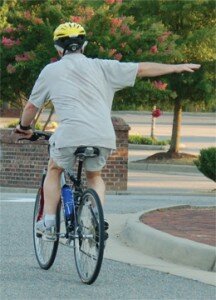
 Before turning or moving laterally, always look behind for, and yield to, any closely approaching traffic in your new line of travel. To signal a left turn, look behind and then hold out the left arm. To signal a right turn, look behind and then either hold out the right arm or hold the left arm up, with a bent elbow up. Return both hands to the handlebar before turning to maximize control while turning. To signal a stop, hold either arm down at an angle, but use both hands for braking when necessary. Beware that squeezing the front brake too hard may cause you to be thrown from the bike.
Traffic signals
 Some traffic signals are triggered by electrically charged wires buried under the pavement. When a vehicle goes over them, the metal disrupts the current, which trips the signal. Most bicycles contain enough metal to trigger the light when stopped over it. In some cases there is camera detection. To trigger a camera, “white line get behind” is common practice. If a light is not triggered, a bicyclist can move forward to let a car trigger the signal, go to the sidewalk and cross with pedestrians, or proceed with caution after waiting two minutes or through two cycles if all traffic is clear.
Bicycling with traffic
 According to the National Highway Traffic Safety Administration, speeding and inattention are the most common unsafe driving behaviors that result in fatal crashes. Driver unpredictability and a bicyclist’s lack of confidence can make bicyclists timid when riding with traffic.
In Virginia bicycles are vehicles. Bicyclists and motor vehicle drivers share mutual rights and responsibilities as users of public roads. When bicyclists are in command of their vehicles and when motorists see bicyclists acting predictably, the highways are safer for everyone.